Foundations and towers for offshore wind power, from monopiles to jackets, are built by assembling thick sheets of high-strength steels that must be welded with clean and repeatable edges. GBC Industrial Tools’ range plate bevelers from 6 to 120 mm with cold machining, without the heat-affected zone of flame or plasma processes, covering ferrules, transition pieces, jacket knots and secondary steel. Above 120 mm, edge preparation is carried out by special custom-built machines, both stationary and portable.
What is prepared in carpentry for offshore wind
An offshore wind farm is, from the point of view of metal carpentry, a set of large steel cylinders and nodes to be assembled by welding: the ferrules that make up monopiles and towers, the transition pieces that connect the foundation to the tower, the nodes and members of the jackets in installations on deeper seabeds, and the so-called secondary steel, i.e. platforms, stairs, walkways and accessory structures that complete the work. Each of these elements is made from calendered sheets or flat plates whose edges must be prepared with a correct chamfer profile before welding.
This is how GBC machines are used in this context: plate beveling machines prepare the edges of the sheets before welding, the grinders pick up and finish seams and surfaces after welding, the pipe cutters intervene on the tubular elements.
The perimeter of the offshore wind sector also includes components that come completely out of steel, such as rotor blades, which are made of advanced composite materials such as carbon fiber and reinforced resins.
Why sheet metal edging is a critical step on high-strength steels
Offshore wind turbine support structures, including steel towers and foundations such as monopiles and jackets, fall within the scope of the DNV-ST-0126 standard, which sets out structural design principles and includes requirements on materials and execution. On the execution side of steel structures, the EN 1090-2 standard defines the execution classes (EXC1-EXC4), from a minimum set of requirements to a more stringent one depending on the consequences of a possible failure and the production category of the structure.
In practice, for the fabricator this means that the edge of the sheet metal must arrive at the weld with a constant bevel angle, without irregularities and without the heat-affected zone typical of flame or plasma processes, which locally weakens the material and complicates controls. This is where the choice of technology becomes crucial: a cold mechanical chamfer reduces the variables to be checked before moving on to welding and maintains the mechanical characteristics of the steel along the machined edge.
GBC’s range for edge preparation
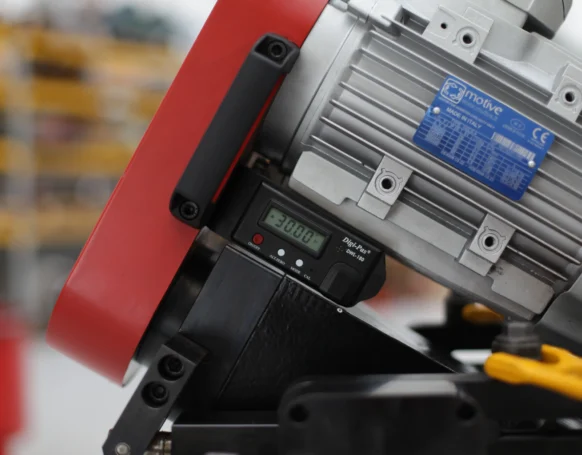
GBC Industrial Tools produces a range of portable plate beveling machines designed precisely for this type of processing on high-strength steels and large thicknesses.
The Edge 80 processes sheet metal from 6 to 120 mm with standard chamfer adjustable from 10° to 70° and J chamfer from 0° to 30°, on carbon steel, stainless steel, duplex, Inconel and aluminum.
The Multiedge 80 covers the same thickness range, 6-120 mm, and adds standard chamfering, facing and peeling in a single machine, with two LCD displays to set the angle and depth precisely. The machine is also suitable for heavy, naval and nuclear carpentry, sectors that share the same need for repeatable edges on high thicknesses with offshore wind.
For intermediate thicknesses, the Compact Edge chamfers sheet metal from 6 to 60 mm with an angle head that varies from 15° to 60°, designed for heavy carpentry and shipyard, while the Basic Edge 50 works in the same thickness range with an angle ranging from 10° to 70° and automatic feed, suitable for heavy carpentry, metal construction and bridges. Both are portable and allow you to intervene directly on the edge of the piece in the workshop, without moving large sheets to a fixed machine.
On secondary steel and lighter elements, where thicknesses remain low, the Challenge processes sheet metal from 6 to 40 mm with its nibbling technology, without producing sparks: a useful feature wherever you prefer to reduce the risk of ignition during workshop work.
The limit of portability: what happens beyond 120 mm
GBC’s catalogue range covers thicknesses up to 120 mm, which is the upper limit of portable chamfering. Beyond this thickness, the type of machine changes: for the most massive pieces of offshore carpentry, where the sheets exceed the capacity of the range machines, it is possible to build special machines tailored to the customer’s application, both stationary and portable. This is something that should be considered already in the workshop planning phase, because the choice between a portable range machine and a special machine depends directly on the maximum thickness that the workshop must work in series.
Beading and processing of tubular elements
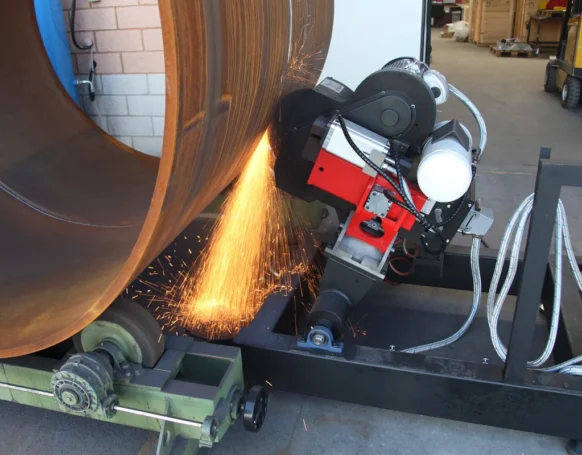
The prepared edge is only one part of the work cycle. After welding, the recovery and finishing of the seams on the cylindrical surfaces of ferrules and transition pieces typically rely on grinders such as the G400, semi-automatic with electronic control of the thrust during removal, suitable for smoothing cylindrical bodies, poles, cones and bottoms, and the G800, which removes material on thicknesses up to 250 mm and integrates as standard a remote control console with CCTV system to operate remotely from the workpiece. Where the structure includes tubular elements, the Supercutter pipe cutter covers even the harshest environments: it is suitable for cutting and chamfering metal pipes in hostile conditions, including offshore platforms.
These three types of machines, plate beveling machines, grinders and pipe cutters, cover the main phases of the preparation and finishing of metal carpentry for offshore wind power, from raw sheet metal to the finished weld seam.
Equipping the workshop for offshore wind carpentry
Those who fabricate foundations, towers or secondary structures for offshore wind almost always process varying thicknesses on the same part, from the thinnest ferrules to the reinforced knots of jackets, and need a range of plate bevelers that cover this range without having to change machines at each pass. GBC’s range meets this need from 6 to 120 mm, with the G400 and G800 edging machines completing the cycle on the recovery of the beads and the Supercutter pipe cutter covering the tubular elements in difficult environments.
To evaluate which combination of machinery best suits the thicknesses and chamfer profiles required by your project, you can consult the GBC sheet metal bevelling range or contact the technical team directly via the Contact page.