Welding pressure vessels and tanks requires edge preparation that ensures complete joint penetration, as required by ASME Section VIII and the PED Directive 2014/68/EU. GBC sheet metal beveling machines, especially Edge 80, Multiedge 80 and Compact Edge, perform standard bevels and J-bevels on thicknesses from 6 to 120 mm without altering the material with heat.
Why Edge Preparation Matters for Pressure Vessels
In the construction of a pressure vessel or tank, welding defects are only permitted within strictly codified limits. In the United States, ASME Section VIII establishes mandatory requirements for the design, manufacture, inspection, testing, and certification of pressure vessels, whether fire-heated or not, operating at internal or external pressures greater than 15 psig. Paragraph UW-35(a) is clear: all butt welds must have complete penetration and fusion along the entire thickness of the joint.
Why Edge Preparation Matters for Pressure Vessels
In the construction of a pressure vessel or tank, welding defects are only permitted within strictly codified limits. In the United States, ASME Section VIII establishes mandatory requirements for the design, manufacture, inspection, testing, and certification of pressure vessels, whether fire-heated or not, operating at internal or external pressures greater than 15 psig. Paragraph UW-35(a) is clear: all butt welds must have complete penetration and fusion along the entire thickness of the joint.
What bevels do pressure vessel manufacturers require
Tank and pressure vessel manufacturers mainly process sheet metal from 10 to 40 mm thick. The choice of the machine, however, does not depend on a fixed thickness band, but on the bevel geometry required by the joint design.
In most cases, these are simple bevels at standard angles, typically 30°, 37.5° or 15°, made on one side of the edge only. A minority of orders, around 10-20% compared to the standard, instead require a J-bevel with R6 or R8 radius, a geometry that reduces the volume of filler material required and optimizes welding on high thicknesses. This machining is a specific feature of Edge 80 and Multiedge 80.
C’è poi una casistica meno frequente ma ricorrente: la smussatura del lato inferiore della lamiera, required in about 20-30% of cases compared to standard configurations. For these applications, GBC offers the Compact Edge Reverse and Edge 80 Reverse versions, which perform the same chamfer but work on the lower edge of the sheet metal, which is particularly useful in view of the calendering of the plating.
GBC machines for chamfering thick sheets
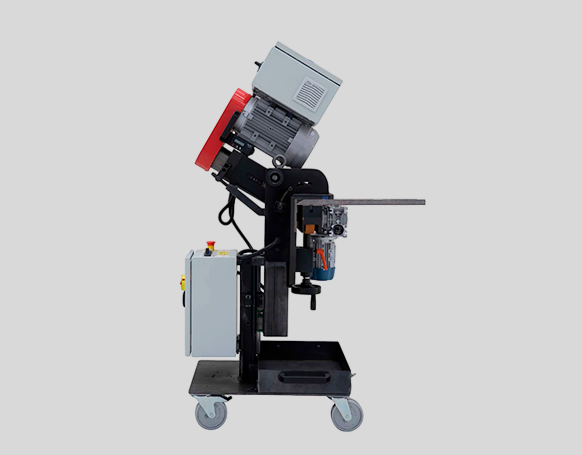
For the typical thicknesses of pressurized boilers, GBC offers three complementary models in the sheet metal chamfering range.
Edge 80 covers thicknesses from 6 to 120 mm with a maximum diagonal of 80 mm. It performs standard beveling at angles from 10° to 70° and J-chamfer from 0° to 30° with R6 or R8 radius, with automatic feed and sheet metal detection sensor for consistent execution along the entire edge.
Multiedge 80 starts from the same thickness range, 6-120 mm, but adds facing and cladding in addition to the standard and J-bevel. The two LCD displays for angle and depth allow machining to be set up with repeatable accuracy, an advantage when the same department alternates between standard and J-bevels on the same production run.
Compact Edge is designed for thicknesses from 6 to 60 mm with angles from 15° to 60°. The variable angle head allows for quick angle changes, while the double cushioning system compensates for variations in thickness and edge misalignment, a common condition on large diameter plankings. For intermediate needs, with automatic feed over the same thickness range as Compact Edge, GBC also offers Basic Edge 50.
Customers who replace other cutting technologies with these beveling machines report two concrete advantages: speed of execution and no alteration of the material, therefore zero HAZ on the edge that will be welded.
Materials and tools for critical alloy steels
The most processed material with these machines remains iron in all its types, but a significant part of the orders concern alloy steels used in the field of pressure vessels, such as duplex and Inconel. Materials with high hardness and toughness that require a consistent tool: The tips mounted on Edge 80, Multiedge 80 and Compact Edge are titanium-coated carbide, with different specifications depending on the material to be machined, so that the cutting edge is maintained even on hard-to-remove alloys.
Operational limits to be considered during the design phase
GBC plate beveling machines adapt to most of the plating geometries encountered in the workshop, including moderately curved surfaces. The practical limit to be kept in mind during the planning phase concerns curved sheets with a radius of less than 3000 mm: below this threshold the curvature becomes too narrow for the machine to follow the edge correctly.
Choosing the right beveling machine and talking to GBC
For a pressure vessel or tank, the choice between Edge 80, Multiedge 80 and Compact Edge depends on the bevel geometry required by the joint design, not just the thickness of the sheet metal: standard bevels, R6/R8 J-chamfers or underside machining require different configurations. The complete range can be found in the GBC plate beveling machines category.
For an evaluation of the most suitable model for the thickness, material and chamfer geometry required by your welding cycle, you can contact the GBC technical team.