In desalination and water treatment plants, the cutting and beveling of pipes are carried out with cold machines, capable of preparing the joint for welding without altering the properties of the material with the contribution of heat. GBC offers a range of pipe cutters for this sector with the MCA Cutter, FAST and Supercutter models as a reference, flanked by portable pipe bevelers and stationary machines, dedicated to workshop preparation. All the solutions in the range are designed to work with maximum efficiency and precision on a wide variety of corrosion-resistant materials, including stainless, duplex and super duplex steels.
Why pipe preparation is important in a desalination plant
Desalination plants are widespread on a global scale: according to IDRA, the international association of the sector (formerly IDA), there are about 22,000 plants operating worldwide that supply water to over 300 million people. Whether it is reverse osmosis (SWRO) or thermal processes such as MSF, each plant is a system of pipes of great extension: intake and discharge pipes, supply lines, collectors, distribution networks of treated water.
All these lines reach the welding phase after cutting and chamfering operations have been carried out. Irregular preparation compromises the quality of the joint and leads to an inevitable lengthening of processing times. GBC cold cutting and chamfering machines solve this critical issue at the source: they cut and chamfer the pipe by mechanical processing, avoiding the formation of heat-affected areas and returning a perfectly prepared flap ready for welding, both on site and in the workshop.
Stainless steel, duplex and super duplex: the same range of machines
Seawater is an aggressive environment, and the technical literature on SWRO plants devotes ample space to the selection criteria of materials and alloys: a review published in the Malaysian Journal of Applied Sciences analyzes in detail precisely which categories of duplex steels are suitable for desalination plants and guarantee the necessary corrosion resistance. For those involved in the construction or maintenance of the plant, however, the fundamental practical requirement lies in a direct question: is the machine to be chamfered or cut able to efficiently and reliably process the specific material selected by the designer?
For GBC, the answer is direct and immediate: the entire range of machines is designed to work carbon steel, stainless steel, duplex, super duplex, Inconel, titanium, copper and related alloys with maximum efficiency. The transition from duplex to super duplex does not involve changes for GBC machines, which in most cases use the same standard configuration. The customer defines the most suitable alloy according to the operating conditions of the system and the machine adapts with the sole integration of specific and dedicated tools where required by the characteristics of the material.
Pipe cutters for pipelines and manifolds: MCA Cutter, FAST and Supercutter
For on-site cutting and beveling operations, the choice starts directly from the GBC family of cold pipe cutters. The MCA Cutter is a split-frame machine with an aluminum structure that is divided into two sections, allowing a single operator to easily install it on pipes with an external diameter from 33.4 to 1095 mm, both in the workshop and on site and anywhere on the line. Thanks to the optional angular gearbox, it adapts perfectly even to extremely confined operating spaces.
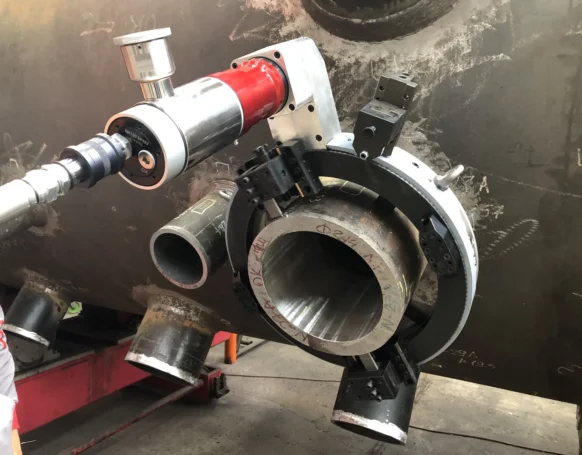
The
FAST also belongs to the
split-frame category and combines a unique
self-centering system with an extended working range from 153 to 1545 mm (6″-60″). The automatic feed and the integrated copying system allow to effectively compensate for any irregularities and ovalizations of the pipe, a crucial aspect in the field of large diameter pipes. The
Supercutter, on the other hand, is a
clamshell type machine: the body opens like a hinge around the pipe for quick positioning along the line, covering diameters between 168 and 1530 mm. It performs automatic cutting and beveling by means of a tool and can be integrated with an optional accessory dedicated to internal machining.
The fundamental difference between split-frame and clamshell architecture lies solely in the opening mechanism around the tube. All three lines guarantee very high precision cold cutting and chamfering and offer maximum motorization flexibility, with pneumatic, hydraulic, electric or brushless power supplies.
Large diameters: Hypercutter and TAF
The intake ducts, discharge ducts and large manifolds of the main plants reach dimensions that require the use of dedicated machines. The Hypercutter covers a range of diameters from 1524 to 2540 mm (60″-100″), offering a hydraulic power supply and an openable body that can be installed anywhere on the line. The TAF, on the other hand, adopts a chain anchoring system, based on two side chains and a central guide band, which starts from an external diameter of 406.4 mm and guarantees a potentially unlimited working range. Available with pneumatic or hydraulic power, the TAF is able to chamfer on wall thicknesses up to 50 mm in its hydraulic configuration.
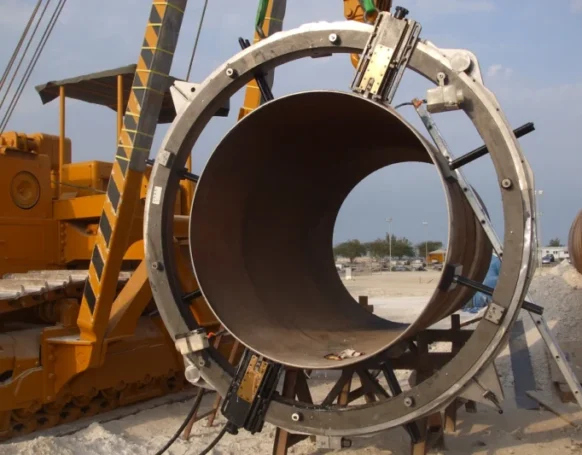
The Supercutter, on the other hand, has no theoretical limits of workable thickness, as GBC designs and manufactures dedicated tools for any application need. Thanks to the optional angle drive, the machine is able to operate effectively on thick-walled pipes even in small space conditions, while the optional micrometric accessory allows the overall preparation of the flap to be completed with extreme accuracy.
Pipe beveling machines and stationary joint preparation machines
Alongside large pipelines, the systems include numerous medium-diameter sections that require careful preparation and beveling with highly repeatable precision before assembly. For these applications, GBC offers its own line of portable pipe beveling machines, consisting of 14 different models. The Supermaxi 7_24, for example, operates on internal diameters from 180 to 504 mm (extendable up to 24″ via optional kit) and is able to perform both internal and external turning, tapering and beveling operations using interchangeable tools. It is an ideal solution for machining in piping, welding workshops and on-site construction sites.
When tube preparation takes place in series in the workshop, the SB500 and SB600 stationary machines provide a high-performance fixed workstation, covering external diameters from 114 to 508 mm and 254 to 609.6 mm respectively. The strategic combination of portable and stationary machines allows you to optimize prefabrication flows in the workshop and manage on-site interventions while maintaining the same operating philosophy based on cold working.
Fiberglass and HDPE pipes: dedicated solutions
Water treatment plants also use non-metallic pipes, such as GRP (fiberglass) and HDPE. GBC machines can also be used on these materials, in most cases with dedicated solutions, to be evaluated on a case-by-case basis with GBC’s technical department. It is therefore essential to indicate the material, diameter and thickness of the line from the beginning, so as to define the most suitable tool and configuration together.
Desalination plants in the Gulf countries and North Africa: Egypt, Algeria, Libya
In the Gulf countries, desalination is the main source of drinking water supply. According to an IFRI study in 2022, desalinated water meets 90% of drinking needs in Kuwait, 86% in Oman, 70% in Saudi Arabia and 42% in the United Arab Emirates. These are critical infrastructures designed to remain operational for decades, whose lines require continuous expansion, maintenance and replacement over time.
In North Africa, seawater desalination is also one of the strategic pillars to ensure the water supply of coastal areas. Algeria has set the goal of reaching a capacity of 5.6 million cubic meters per day of desalinated water by 2030, in accordance with the national plan promoted by Sonatrach. In Egypt, the development program coordinated by the Sovereign Wealth Fund provides for the installation of plants with a total capacity of 8.85 million cubic meters per day by 2050, as confirmed by the directives of the pre-qualification communiqué. Finally, in Libya, coastal desalination stations complement the existing infrastructure to serve the main urban centers of the coast.
On construction sites in these development-intensive regions, the Gulf countries and North Africa, operational priorities focus on two key aspects: ease of positioning equipment on site and compatibility with power sources available in the field. Pipe cutters with split-frame and clamshell architecture directly address these needs, allowing quick mounting around the pipe in any section of the line. The MCA Cutter, FAST and Supercutter models offer maximum operational flexibility thanks to the availability of pneumatic, hydraulic, electric or brushless motors.
The configuration is defined with the GBC technical team based on diameter, material and type of intervention, in the workshop or on site. GBC follows the customer with assistance, start-up and training of operators.
A complete range for desalination and water treatment plants
For the pipes of desalination plants, GBC provides machinery for the cold cutting and chamfering of stainless steels, duplex and super duplex, covering a range ranging from medium-diameter lines to large adduction pipelines. These solutions have been widely tested and used in major international projects, from North Africa to the Middle East to markets all over the world. The entire range of pipe cutters, pipe bevelers and stationary machines for the processing of these alloys can be consulted in the official GBC catalogue.
To locate the right model for your project, contact the GBC technical team providing details of diameter, material and thickness of the pipes.