When certain thicknesses are exceeded, the simple V-bevel bevel loses its effectiveness and it is necessary to switch to J-bevel or U-groove type geometries, specifically designed to reduce the overall volume of filler material to be deposited and to ensure better access to the root of the joint. GBC Industrial Tools manages these complex processes on pipes through the machines of the pipe milling line and on sheet metal through the Edge 80 and Multiedge 80 models, where the specific execution of the U-bevel on the pipes is entrusted to the dedicated edging machines of the range. Finally, the configuration of the tools for the J-profiles takes place on request, based on the technical drawing and the dimensional profile provided by the customer.
Why simple beveling is not enough on high thicknesses
The preparation of the joint for welding determines the amount of filler material required, the heat distribution and the degree of accessibility to the root during the subsequent passes. On low thicknesses, a V-bevel with a standard angle meets most operational requirements. However, as the thickness increases, this same geometry leads to a significant increase in welding times, an increase in deformations and an excessive filling volume: it is precisely at this stage that the use of preparations with more complex geometries is necessary.
The UNI EN ISO 9692 series is the fundamental technical reference that correlates the geometry of the bevel to the welding process, the thickness and the conformation of the joint (UNI EN ISO 9692-1). As far as pipes are concerned, the ASME B16.25 standard regulates the preparation of the ends of the components to be joined by welding, defining both the geometries of the bevel and the forming of thick-walled components (ASME B16.25). The guiding principle of both standards remains the same: above a certain thickness threshold, the preparation of the joint ceases to be a simple bevel cut and is transformed into a controlled profile processing. It is precisely in this context that GBC’s cold beveling machines fit in, developed to reproduce these geometries with high precision and repeatability, both on tubes and sheets.
J bevel: rounded geometry, less material to fill
The J bevel differs from the V bevel by the shape of the joint wall, which no longer appears as a straight inclined plane, but as a rounded surface connected by a well-defined radius. This particular geometry makes it possible to obtain a significantly smaller volume of chamfer than a simple chamfer with the same thickness, generating direct benefits in welding execution times and in the overall amount of deposited filler material.
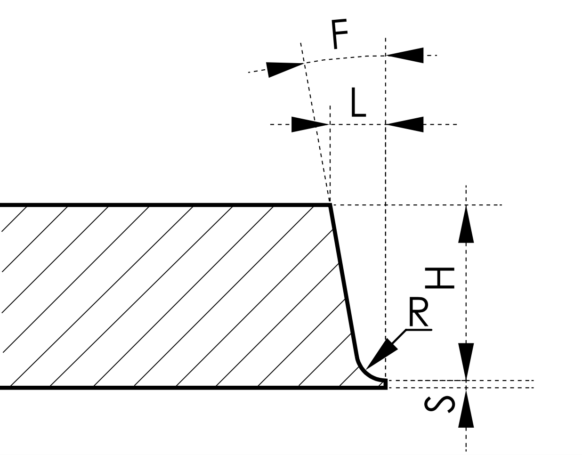
J-groove
For sheet metal processing, GBC manufactures the J-bevel using Edge 80 and Multiedge 80 machines: both models are suitable for handling thicknesses between 6 and 120 mm and integrate the predisposition for the J-bevel with R6 and R8 radii and adjustable angle from 0° to 30°, combining this functionality with the standard beveling (from 10° to 70°). The Edge 80 is the ideal solution for automatic beveling on large thicknesses; the Multiedge 80 enriches this performance by integrating the facing and deplating operations, as well as the presence of two LCD displays dedicated to the millimetric setting of the angle and depth of the chamfer.
On pipes, GBC’s range of pipe cutters and pipe bevelers include models capable of making V bevels, J bevels and other complex geometries, adapting to the specific diameter and available access spaces. As far as tooling solutions are concerned, in the case of the monobloc configuration GBC is able to shape any radius actually required by the joint design; the interchangeable plates, on the other hand, cover the standard range radii. This is a fundamental distinction to be considered already when requesting a quote: if the profile envisaged in the project has a special or non-standard radius, the monobloc tool allows it to be reproduced with absolute fidelity.
U bevel on the pipe: the solution with GBC edging machines
The U-bevel evolves the J-bevel principle, offering an even more rounded joint wall and a narrower root. It is the standard geometry for high thicknesses, specifically designed to minimize the volume of filler metal to be filled during welding.
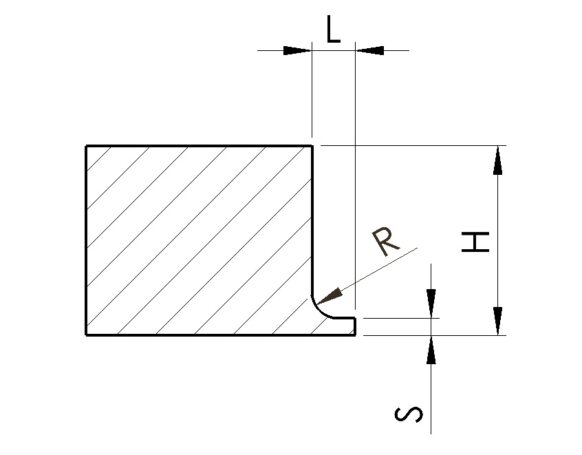
U-bevel
On tubular components, GBC manufactures the U-bevel through its range of grinding machines, in particular with the G300, G400 and G800 models, machines designed for high-precision recovery and finishing operations. The G800, for example, is an automatic multifunction grinding machine equipped with an 800 mm disc, capable of removing material on thicknesses up to 250 mm. It is equipped as standard with a remote control console with integrated CCTV system, ensuring maximum control and maximum safety in the heaviest processes.
For those involved in joint design, the flexibility of the GBC catalogue offers a concrete advantage: if the technical drawing includes a U-shaped chamfer, GBC is able to identify the ideal edging machine already in the specification phase, combining it with the classic pipe bevelers used in the other phases of line preparation.
Compound bevels and custom tools: the role of the dimensioned profile
J-shaped and U-shaped profiles do not exhaust the range of special geometries. When the complexity of the project requires it, GBC also produces compound bevels characterized by the combination of several angles or several radii on the same joint wall, typical solutions of very thick applications where a simple geometry does not allow sufficient control of the filling volume.
In each of these circumstances, the commercial and technical process follows a well-defined path: the tools are developed entirely on request from the documentation provided by the customer, which defines the precise shape of the chamfer and the related manufacturing dimensions. It is a personalized service that transforms the technical drawing of the joint into a tool designed specifically for the specific geometry prescribed.
The demand for these advanced configurations comes mainly from the petrochemical and boiler sectors, areas in which the high thicknesses and the strict quality requirements of the welds are the operating standard. For companies in the sector, the concrete benefit lies in the availability of an integrated offer that manages both tube processing (using pipe cutters and pipe bevelers prepared for custom-made radii in the monobloc version) and sheet metal processing (with Edge 80 and Multiedge 80 sheet metal chamfers, equipped with the J-bevel R6/R8 system as standard), eliminating the need for complex manual interventions and ensuring high repeatability even on shaped surfaces.
From the height of the joint to the most suitable machine
For those who manage projects with thick joints and have already defined the required chamfer geometries, the quickest starting point is to consult the GBC product range or to send the dimensioned profile of the joint directly through the contact page. This approach allows GBC technicians to immediately identify the most suitable machine or to design the tool to order that perfectly meets the required technical specifications.