The choice of a pipe stand depends on four main variables: the weight of the pipe and the required load capacity, the type of operation (static support, rotation, or longitudinal movement), the working environment (workshop or job site), and the pipe material. Each combination of these factors leads to a specific configuration of the base and support head. The interchangeable head system also allows the same stand to be adapted to multiple functions without replacing the supporting structure.
Why the wrong support compromises results
A pipe that is not properly supported during cutting or beveling is subject to unwanted movement. Even minimal displacement can compromise the perpendicularity of the cut or the uniformity of the bevel, directly affecting the quality of the subsequent weld. Instability during machining generates vibrations that accelerate tool wear, lead to avoidable rework, and increase production time.
The issue is not limited to geometric precision. An undersized stand relative to the actual weight of the pipe represents a real risk for the operator. Large-diameter, thick-walled steel pipes can weigh hundreds of kilograms: load capacity selection is not merely a cost-related parameter, but a critical safety factor.
There is also a frequently overlooked aspect: an unsuitable stand is not only one that is too weak. A head that is not appropriate for the operation—such as a V-head used where rollers would be more suitable—can create unnecessary friction, make repositioning difficult, and damage sensitive surfaces such as stainless steel.
Choosing the right support therefore means starting with four practical questions.
First variable: load capacity
The primary selection criterion is the actual weight of the pipe—not its diameter or length. A large-diameter carbon steel pipe with thick walls can be significantly heavier than expected, and the load is distributed across all stands supporting it simultaneously.
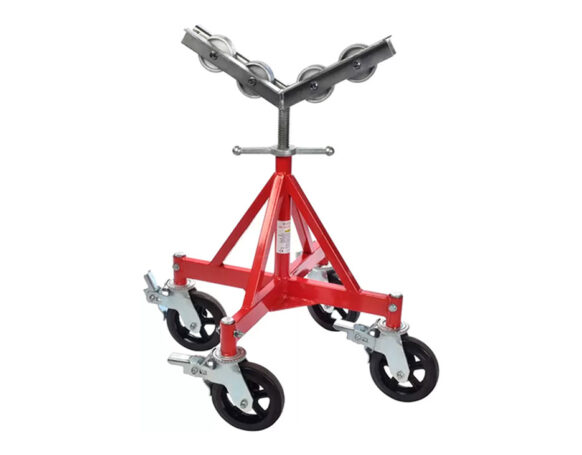
The GBC range covers capacities from 450 kg to 2,500 kg per stand, addressing a wide variety of operational needs
The PJ1 model is the most compact solution, with a load capacity of 450 kg, ideal for small to medium diameter pipes during machining and assembly operations.
The PJ3 reaches 1,000 kg and features a triangular base structure.
The PJ4 supports pipes up to 48″, with a load capacity of 2,000 kg.
At the top of the range is the PJQ, with a certified capacity of 2,500 kg per stand, designed for heavy-duty applications involving large-diameter, thick-walled pipes. For a detailed analysis, refer to the dedicated article on PJQ stands.
A simple rule of thumb: calculate the total weight of the pipe section to be processed and divide it by the number of stands used. The result must be lower than the nominal capacity of the selected stand, always including an appropriate safety margin.
Second variable: type of operation
Once the load capacity has been determined, the second criterion concerns the function the stand must perform. The configuration changes depending on the processing phase: static support during cutting or beveling, controlled rotation, or longitudinal movement for repositioning.
This flexibility is ensured by the GBC interchangeable head system: the base remains the same, while the head can be selected and replaced according to the operation.
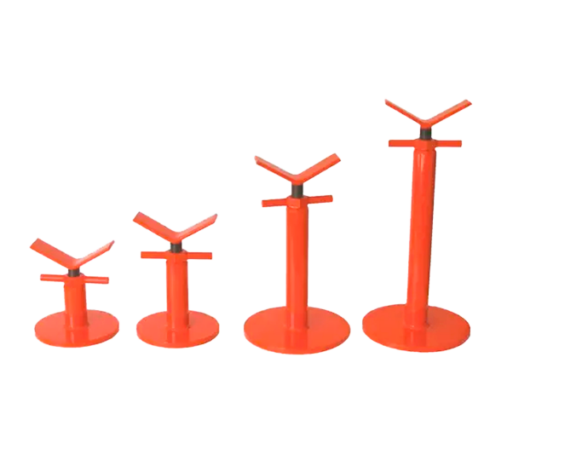
V-head: stability for cutting, beveling, and fixed-position welding
The V-head is the standard configuration for all operations requiring the pipe to remain stationary. Its geometry automatically centers the pipe and stabilizes it against lateral movement, which is a major issue during milling or orbital cutting. The standard V-head is typically used for pipes up to approximately 12″, while larger diameters require the large version (LVH), which on the PJ4 covers pipes up to 24″. On the PJQ, thanks to its more robust structure, diameters up to 36″ can be handled.
On models with folding legs or lockable wheels, the V-head is also used on-site for positioning before butt welding, in combination with alignment clamps.
Roller heads: controlled rotation during welding
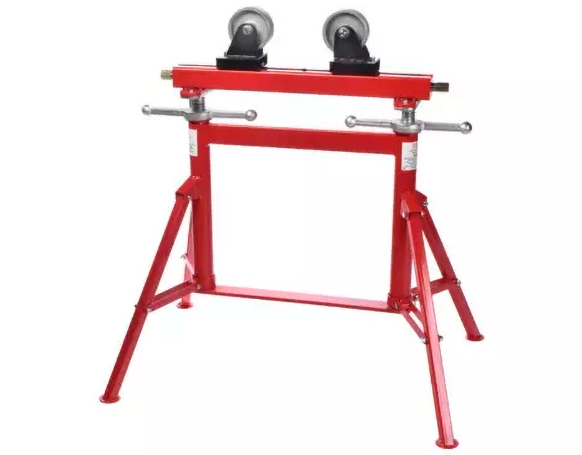
When the pipe needs to be rotated around its axis during welding, roller heads provide the most efficient solution. Parallel rollers support the pipe and allow smooth rotation with minimal effort while maintaining constant height. This is crucial, as any variation in height during welding results in irregular weld beads.
Roller heads are available with steel, nylon, or polyurethane wheels, depending on the pipe material. All versions are interchangeable with V-heads on the same base, enabling quick reconfiguration.
Ball transfers: longitudinal movement
Ball transfer units are plates equipped with spheres that allow multidirectional pipe movement, facilitating sliding and repositioning during machining. They are especially useful when handling long pipes that need to advance progressively or when multiple cuts are required along the same pipe without reconfiguring supports.
Their load capacity is 600 kg per unit. Stainless steel versions (BTK3SS, BTK4SS) are also available for applications involving materials that must not be contaminated by carbon steel.
Third variable: workshop or job site
The same stand can be used both in a workshop and on-site, but operating conditions strongly influence the most suitable configuration. The key factors are stability, mobility, and adaptability to the supporting surface.
In workshops, the environment is typically stable and flat. The goal is to maximize precision and control. Stands such as the PJ4, thanks to their adjustable structure, allow precise height management. Compatibility with accessories like the RPS4 Roller Stand also enables use on benches or floors.
On job sites, conditions are more variable: uneven surfaces, frequent transport, and limited setup time. In these cases, portability and ease of use become essential. Models like the PJ3 with folding legs (PJ3FLB) facilitate transport and storage without compromising performance. For more demanding applications, the PJQ integrates leveling systems to compensate for uneven ground, improving stability. Lockable wheels also allow more efficient pipe positioning.
The distinction between workshop and job site therefore concerns the overall configuration of the stand and its accessories, not just the model itself.
Fourth variable: pipe material
Carbon steel and stainless steel require different approaches. Standard steel wheels can leave iron traces on stainless steel surfaces due to direct contact—a critical issue in food, pharmaceutical, and other industries working with sensitive materials such as duplex, super duplex, or Inconel. This contamination is not merely aesthetic; it can compromise corrosion resistance.
The solution is to use nylon (NWK3, NWK4) or polyurethane (PWK3, PWK4) wheels, which eliminate metal-to-metal contact. For more demanding applications, GBC offers versions with stainless steel wheels and ball transfers (SS suffix), compatible with all models in the range
Wheel material selection must therefore be based on the pipe material: it is a key technical parameter, not a secondary detail.
Interchangeable head system: practical flexibility
One of the most important features of the GBC range is accessory compatibility across different models. V-heads, roller heads, and ball transfers can be quickly installed and removed, and many accessories are shared among PJ1, PJ3, PJ4, and RPS4.
This results in more efficient operations: there is no need to stock separate spare parts for each model, and operators only need to learn one configuration logic. When production requirements change—such as switching to stainless steel processing—it is sufficient to replace the heads without changing the stands.
When a trolley is needed: active handling in workshop and on-site
The Pipe Buggy is not a support stand but a transport tool. This distinction is essential: it addresses the need to move pipes, not to support them during machining
Dragging pipes on the floor can damage surfaces, causing scratches that may become corrosion initiation points and posing safety risks. The Pipe Buggy solves this with a lightweight solution (31.8 kg), equipped with a quick-release handle and ratchet strap, allowing a single operator to lift and transport pipes up to 12″ in diameter and 6.1 m in length, with a load capacity of 450 kg.
It is ideal for internal handling in workshops or job sites where mechanical lifting equipment is unavailable or impractical.
Pipe stands and machining equipment: an integrated system
Pipe stands are not secondary accessories but an integral part of the production process. During cutting, they position the pipe at the correct height for pipe cutting and beveling machines, reducing operator effort and improving safety. During welding, roller heads enable controlled rotation. During pre-welding alignment, stands work in combination with clamps to keep pipe ends correctly positioned before tack welding.
The choice of stand should therefore not be based solely on load capacity or head type, but evaluated within the context of the entire operational process.
Discover the full range of GBC pipe stands and supports, or contact us for personalized advice on the most suitable solutions for your production process.