Stationary pipe beveling machines are a cost-effective choice when production is centralized in the workshop, work is carried out on well-defined diameter ranges, and consistent, repeatable precision is required. In these scenarios, the self-centering clamping system becomes a strategic feature. Compared to portable machines, stationary solutions offer a higher level of automation and uniform machining quality, though they require more space and a higher initial investment.
Portable vs. stationary beveling machines: operational differences
The choice between portable beveling machines and stationary machines depends on the operating environment. Portable beveling machines are mounted directly onto the pipe using internal or external clamping systems, allowing work on pipelines, construction sites, and installations where the pipe cannot be moved.
Stationary pipe beveling machines operate according to the opposite logic: the pipe is brought to the machine and clamped on a fixed bench equipped with a self-centering system. This approach radically changes production dynamics. The operator positions the pipe, the machine automatically centers and clamps it on-axis, and the beveling operation proceeds without the need for continuous manual adjustments.
When work is always carried out in the same location and material arrives at the workshop, the stationary machine eliminates repetitive setup times. For interventions on existing plants, already-installed pipelines, or large structures, the portable beveling machine remains the only truly practical option.
When self-centering clamping makes the difference
Self-centering clamping represents the main advantage of stationary machines. The SB320, SB500, and SB600 pipe bevelers use jaws that close simultaneously, perfectly centering the pipe with respect to the machine’s axis of rotation.
This system ensures constant concentricity even when the pipe is positioned manually by the operator. The machine compensates for minor positioning inaccuracies, reducing dependence on operator experience. The result is a uniform bevel around the entire circumference, a fundamental requirement for welds that comply with joint preparation standards.
The integrated anti-deformation system of stationary pipe bevelers prevents crushing of thin-walled pipes during clamping. The jaws apply calibrated pressure—sufficient to hold the workpiece securely, but not enough to deform it. This aspect becomes critical when working on stainless steel or duplex piping destined for sectors such as petrochemicals, where even minimal geometric alterations can compromise weld integrity.
Serial production in the workshop
In serial production, repeatability is more important than absolute speed. When preparing large batches of pipes for welding, the stationary machine always operates with the same parameters: identical centering, the same feed speed, and the same bevel depth.
The automatic feed system featured on GBC stationary machines eliminates variability caused by manual operator pressure. The milling head advances at a constant speed, ensuring uniform surface finish across all workpieces. In sectors where ISO 3834 certification requires complete process documentation, this consistency becomes an essential requirement.
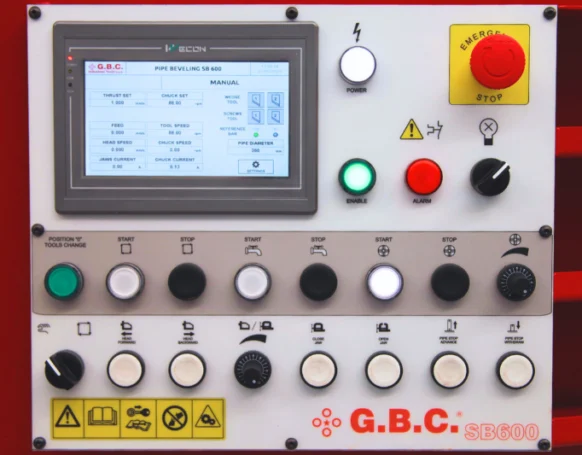
Diameter ranges and capacity of GBC stationary pipe bevelers
The GBC stationary range covers a wide spectrum of diameters thanks to three distinct models. The SB320 machines pipes with an external diameter from 33 to 320 mm (1 1/2″–12 3/4″), positioning itself as the ideal solution for workshops operating on smaller diameters. Medium-sized industrial plants find this model well suited to their needs.
The SB500 handles diameters ranging from 114 to 508 mm (4″–20″). Its operating range partially overlaps that of the SB320 at the lower end, while extending toward larger diameters typical of applications in sectors such as shipbuilding, oil & gas components, and industrial fabrication.
For the most demanding applications, the SB600 covers diameters from 254 mm (10″) up to 609.6 mm (24″). Distribution pipelines, large energy plants, and offshore structures require this level of capacity. Its power and structural robustness allow continuous machining of difficult materials such as Inconel and super duplex, where cold mechanical beveling avoids the metallurgical alterations typical of thermal cutting.
Investment analysis: factors to consider
In addition to the financial investment required to purchase a stationary machine, it is essential to allocate dedicated workshop space with sufficient area for handling incoming and outgoing pipes. A stationary pipe beveler such as the SB600, for example, requires a larger working area than a portable machine that moves to the workpiece, but this surface becomes highly productive when the machine operates continuously.
Production type is a determining factor when assessing the return on investment. Workshops that mainly work on custom jobs with constantly changing specifications may not fully benefit from automation. Conversely, those producing repetitive components for industrial plants can recover the investment through reduced setup times and consistent quality, which minimizes scrap.
The materials being machined also influence the choice. Standard carbon steel is easier to machine than materials such as duplex, super duplex, and Inconel, which require extremely precise parameters and specific carbide tooling. Stationary pipe bevelers maintain these parameters consistently cycle after cycle, whereas on portable machines, adjustments depend more heavily on operator skill.
Another advantage is the reduced investment in personnel training. Automatic clamping and controlled feed systems lower the level of expertise required to achieve compliant results. An experienced operator optimizes cycle times, but even personnel with basic training can work safely while producing high-quality bevels.
When the portable beveler remains preferable
Portable pipe beveling machines retain irreplaceable advantages in specific contexts. Shipyards, offshore installations, and maintenance activities on existing pipelines require machines that can be easily transported and used directly at the job site.
When diameters vary continuously from one job to another—for example, from 2 to 24 inches within the same day—the flexibility of a portable machine compensates for its lower level of automation. Stationary machines, by contrast, deliver maximum performance on defined diameter ranges and repetitive production.
For low volumes or occasional interventions, investing in a stationary machine may not be justified. A small workshop that prepares only a few pipes per week with varying diameters will find portable machines to be a more economical and efficient solution. In addition, their compact footprint allows workshop space to be used for other equipment when the beveling machine is not in operation.
Operational advantages of stationary machines
Consistent quality eliminates the main variable of manual machining: the human factor. Even the most skilled technician can be affected by fatigue or lapses in attention; a stationary machine, however, produces the same bevel on the first piece as on the last one of the day.
Automation also improves operational safety. The operator is not required to maintain awkward or strained positions during machining. Tasks are limited to positioning the pipe, starting the cycle, and monitoring the process. Integrated safety systems reduce the risk of accidental contact with rotating tools.
For companies operating under strict welding specifications, process traceability is simplified. Machining parameters can be set and recorded, making certification documentation easier compared to manual processes where each workpiece depends on the operator.
How to choose between GBC models
The choice between the SB320, SB500, and SB600 should start with the predominant diameter range in production. If work is mainly carried out below 320 mm, the SB320 meets requirements with limited footprint and investment. For diameters between 114 and 508 mm, the SB500 offers the ability to machine even thick walls while maintaining high precision.
The SB600 is justified when diameters regularly exceed 400 mm. These sizes are typical of oil & gas applications, large energy plants, and shipbuilding. Its higher power allows machining of tough materials without compromising speed.
The materials typically processed also influence the choice of tools and accessories. Standard carbon steel requires HSS tooling, while duplex and Inconel require carbide inserts. GBC provides specific consultation on the most suitable tooling for each application.
For personalized evaluations and to identify the model best suited to specific production requirements, the GBC technical team analyzes production type, materials, and volumes to recommend the most efficient solution.
Contact us now to receive a personalized consultation.